Ranya Sharma Receives CRA Outstanding Undergraduate Researcher Award
In December, undergraduate Ranya Sharma was honored with a 2025 CRA Outstanding Undergraduate Researcher Award—one of the highest recognitions for early-career computing research in North America. The award, presented by the Computing Research Association, acknowledges Ranya’s standout contributions to understanding how digital infrastructure shapes privacy, performance, and equity across the Internet.
From Early Curiosity to Real-World Impact
 Ranya’s journey began long before college, with curiosity—and a bit of audacity. During her junior year of high school, she cold-emailed Neubauer Professor Nick Feamster, hoping to get a taste of security research. Instead, she found herself at the center of an ambitious project, leading her own research on encrypted DNS (Domain Name System) interfaces. The work was not only her introduction to research, but also became a formative experience in shaping her undergraduate years.
“One of the biggest early experiences was leading my own research project on encrypted DNS while I was still in high school,” Ranya recalls. “It really threw me into the deep end, but in a good way. Having direct ownership of the work meant I also had the responsibility of making decisions and steering the direction of the project, and that made the experience feel authentic and rewarding.”
That early project would lead to her first co-authored publication and the opportunity to present at the USENIX Security Symposium, one of computer security’s most prestigious gatherings. Meeting researchers passionately engaged in the same questions convinced her: this was work she wanted to continue.
Tackling Network Security—and Internet Equity
At UChicago, Ranya’s work has continued to focus on the impact of everyday technology decisions—how choices about Internet infrastructure ripple out to affect people’s lives. Her research tackles questions with immediate relevance:
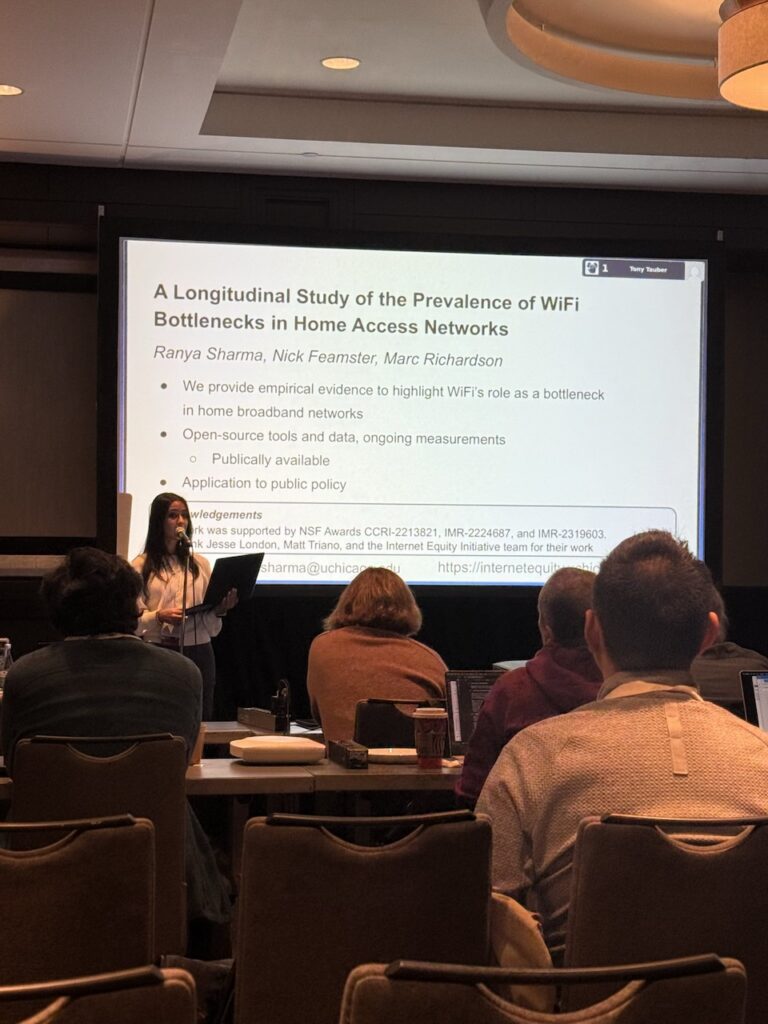 When households pay for high-speed broadband but struggle with slow connections, is home WiFi the culprit?
- Do users really have meaningful choice—or understanding—over which encrypted DNS resolvers their browsers use?
- How can we measure neighborhood-level Internet equity, not just “on paper” but in lived experience?
Ranya has built measurement systems to analyze home network bottlenecks and conducted user studies on privacy controls. Her work revealed that, while many Internet policies focus on top-line speeds, real barriers often persist inside the home or in software defaults—issues that affect millions but are often overlooked.
One of Sharma’s key findings is that, even when households pay for high-speed Internet, it’s often the quality of their home WiFi—not the broadband service itself—that presents the biggest obstacle to better performance. Her research points to the importance of Internet providers, device makers, and policymakers considering not just connection speeds, but also ways to improve in-home equipment and support so all users can get the most from their service.
A Focus on Public Interest Technology
The heart of Ranya’s research lies in what she describes as “public interest technology.”
“Through my work, I hope to make existing systems more transparent and accountable,” Ranya states. “I hope to produce evidence that can inform better design choices and more equitable technology policy.”
Her ongoing thesis explores how network-layer metadata can leak even when encrypted DNS is in use—a project she describes as the culmination of six years of exploration at the intersection of security and public policy. This work not only synthesizes her longstanding interest in digital privacy and infrastructure but also addresses important, real-world questions about the effectiveness and limits of today’s privacy tools. By examining both technical realities and their implications for policy and user experience, Ranya’s research highlights the need for continuous evaluation as technology evolves and societies increasingly depend on secure, accessible internet communications.
Collaboration, Mentorship, and Paying It Forward
Ranya emphasizes the importance of mentorship in her journey, crediting Professor Feamster, her collaborators in the NOISE Lab, and the broader research community for much of her development as a researcher. She sees research as a deeply collaborative process.
“Working in teams and coauthoring papers also showed me that good research is rarely a solo effort,” she explains. “People are generous with their time and ideas, and progress often comes from sharing work early, asking questions, and building on each other’s strengths.”
She also values giving back to her community—whether through mentoring, teaching, or building tools—saying, “We all owe it to the community to put back what we take—my mentors have modeled that, and I try to as well.”
Looking Ahead
As she finishes her undergraduate studies, Ranya remains motivated by curiosity rather than accolades. The CRA award, she says, is “an encouraging affirmation of my passion for research—proof that genuine curiosity matters.” Her advice for other students? Find mentors who care about your growth and focus on the questions that truly excite you, not just on the end goal.
Ranya’s work continues to bridge disciplines and make a tangible difference, whether through influencing technology policy, guiding investments in broadband access, or shaping how millions interact with digital privacy tools. The department congratulates her on this well-earned honor.
“This award recognizes what those of us who’ve worked with Ranya already know,” said Feamster. “She is an undergraduate researcher of the utmost caliber, and, even more importantly, a kind and conscientious person.“
For more details on the CRA Outstanding Undergraduate Researcher Awards, visit the CRA website.