Four UChicago CS students named to Siebel Scholars class of 2027
Three UChicago Computer Science PhD students and one student in the MS in Computational Analysis and Public Policy (MS-CAPP) program were named to the 2027 class of the Siebel Scholars — a program that awards grants to 16 universities in the United States and other countries.
The University of Chicago Department of Computer Science was selected for the Siebel Scholars program in 2017. Since then, 47 UChicago CS students have been chosen by the Thomas and Stacey Siebel Foundation to join the group, which “recognizes the most talented students at the world’s leading graduate schools of business, computer science, bioengineering, and energy science, forming an active, lifelong community among an ever-growing group of leaders,” according to the foundation. This year the foundation selected 72 students to join its network of more than 2,000 scholars, researchers, and entrepreneurs.
This year’s class of UChicago CS Siebel Scholars includes students protecting children’s privacy in AI systems, using computational methods to expand access to legal knowledge, designing screen-free devices for a post-smartphone world, and studying how customization shapes users’ perception of social robots.
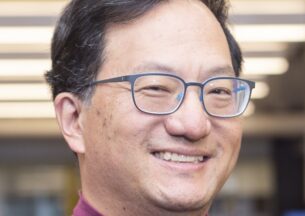
G. Jake Chanenson
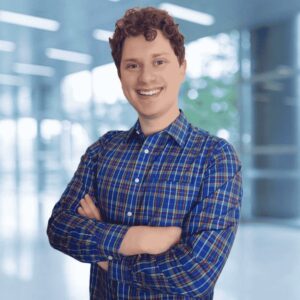 G. Jake Chanenson is a Ph.D. student in computer science at UChicago’s AIR Lab. His research focuses on children’s privacy and AI safety, examining how generative AI systems collect and use data about youth and what happens when those systems fail. He has also worked as a research intern at Google on online safety.
Jake holds a Master of Legal Studies from the University of Chicago Law School and uses his legal training to complement his computer science research by helping him analyze the policy and regulatory implications of emerging technologies.
His work has appeared at top venues like ACM’s CHI and FAccT, informed policy comments to the FTC and European Data Protection Board, and been featured by “USA Today” and “The Markup.” He also teaches UChicago’s introductory computer science course, leads privacy and AI education in Chicago public schools, and hosts the New Books Network’s “Science, Technology & Society” podcast.
María Fernanda Muñoz
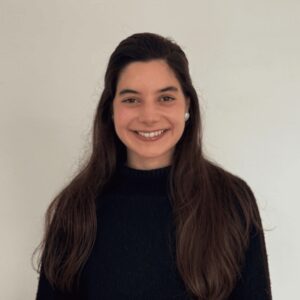 María Fernanda Muñoz earned Bachelor’s degrees with honors in Economics (2017) and Law (2019) from Instituto Tecnológico Autónomo de México (ITAM). She is currently a student in the MS in Computational Analysis and Public Policy (MS-CAPP) program at the University of Chicago. Prior to joining MS-CAPP, Maria worked in the Consejo de la Judicatura Federal where she led the development of a search engine for high-impact court rulings and rose to the level of Technical Secretary. This project is part of Maria’s broader research program to use computational methods to represent, analyze, and expand access to legal knowledge contained in Mexican court rulings. As an undergraduate, Maria volunteered with Enlace Rural where she designed educational programs and coordinated 90+ volunteers. As a member of the ITAM student council, she led efforts to strengthen anti-harassment and sexual misconduct protocols and to improve communication between students and university administrators.
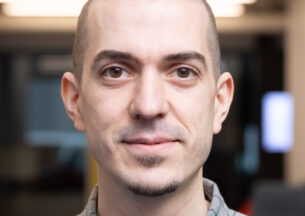
Anup Sathya
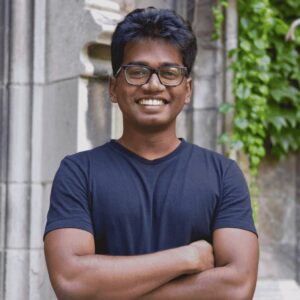 Anup Sathya is a Ph.D. student at the University of Chicago in the Department of Computer Science, advised by Dr. Ken Nakagaki. His research addresses a paradox of our hyperconnected age: the same devices that promise to connect us have eroded attention spans and frayed the social fabric of everyday life. By designing and developing novel devices and interactive systems for the home, his research envisions a screen-free, post-smartphone world where we can maintain digitality without losing our sanity. Anup has published his work at top Human-Computer Interaction (HCI) venues like ACM CHI, UIST, DIS, and UbiComp. His work has received multiple honors such as the 2025 Linda Tischler award, Fast Company’s Innovation by Design Award, and Core77’s Lifestyle Accessories Award. Previously, he developed novel wearables and personal fabrication systems at the University of Maryland.
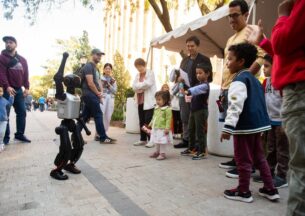
Alex Wuqi Zhang
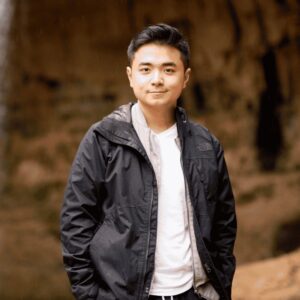 Alex Wuqi Zhang is a Ph.D. candidate in Computer Science at the University of Chicago, where he conducts research in human-robot interaction, social robotics, and user customization of AI-powered robot systems. His work examines how design choices — such as interface granularity, personality control, and robot form factor — shape users’ perceptions of robot agency, authenticity, rapport, and overall experience. He has published work at venues including CHI and HRI, with recent projects exploring end-user robot programming, LLM-generated robot personalities, and how customization can both empower users and alter whether robots are perceived as autonomous social agents. His research combines experimental user studies, embodied robot systems, and interface design. At the University of Chicago, he has worked as a graduate researcher in the Human-Robot Interaction Lab under Prof. Sarah Sebo.