Assistant Professor Aloni Cohen Receives Prestigious Award for Groundbreaking Research in Machine Learning Complexity
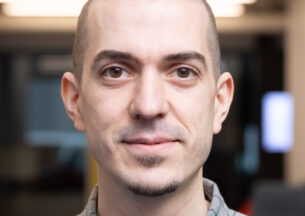
 Assistant Professor Aloni Cohen from the University of Chicago’s Department of Computer Science and Data Science Institute has been honored with an Outstanding Paper Award at the 35th International Conference on Algorithmic Learning Theory (ALT 2024) for his research on the computational complexity of differentially private PAC learning. The conference, renowned for showcasing cutting-edge advancements in machine learning theory, recognized Cohen’s work as a significant contribution to the field.
The paper that garnered Cohen the prestigious award examines a basic question: how hard is private machine learning? The task, more formally called private PAC learning, is to learn to classify data given many examples as training data while also hiding the specifics of any individual training example. At the heart of this work are two fundamental measures of hardness of machine learning: the number of examples and the compute time needed to learn the function.
Titled “Exploring the Computational Boundaries of Differentially Private PAC Learning,” Cohen’s research builds upon the connection between private PAC learning and a different, non-private model of learning called mistake-bounded online learning, or online learning for short. Prior work showed that any function of the data can be online learned, can be privately learned with not too many more examples. But it left open whether the same can be said for compute time.
Cohen and his co-authors, Rathin Desai and Mark Bun, resolve this fundamental question. The answer, they show, is no. Some functions can be easily learned online, but cannot be privately learned without breaking certain cryptographic schemes.
“Modern AI systems like Chat-GPT are trained on simply staggering amounts of data, including data about all of us,” said Cohen. “Privacy is only getting harder. Though still very far from the practice of AI, our work helps illuminate the fundamental limits of privacy in the age of machine learning.”
Cohen’s accolade underscores the University of Chicago’s commitment to fostering groundbreaking research in computer science and machine learning. His innovative contributions serve as a beacon for future endeavors, inspiring researchers to explore new frontiers in the quest for knowledge and technological advancement.
“Controlling data disclosure, which is the goal of differentially private machine learning, is just one aspect of a much larger set of problems,” Cohen said. “There’s still so much we don’t understand about how to make good use of data while respecting the subjects and creators of that data. We mostly don’t even understand what the right questions are, which is part of what makes this research area so interesting.”